
The Golden Ratio in Garden Design: Finding Harmony Through Geometry
Nov 03, 2026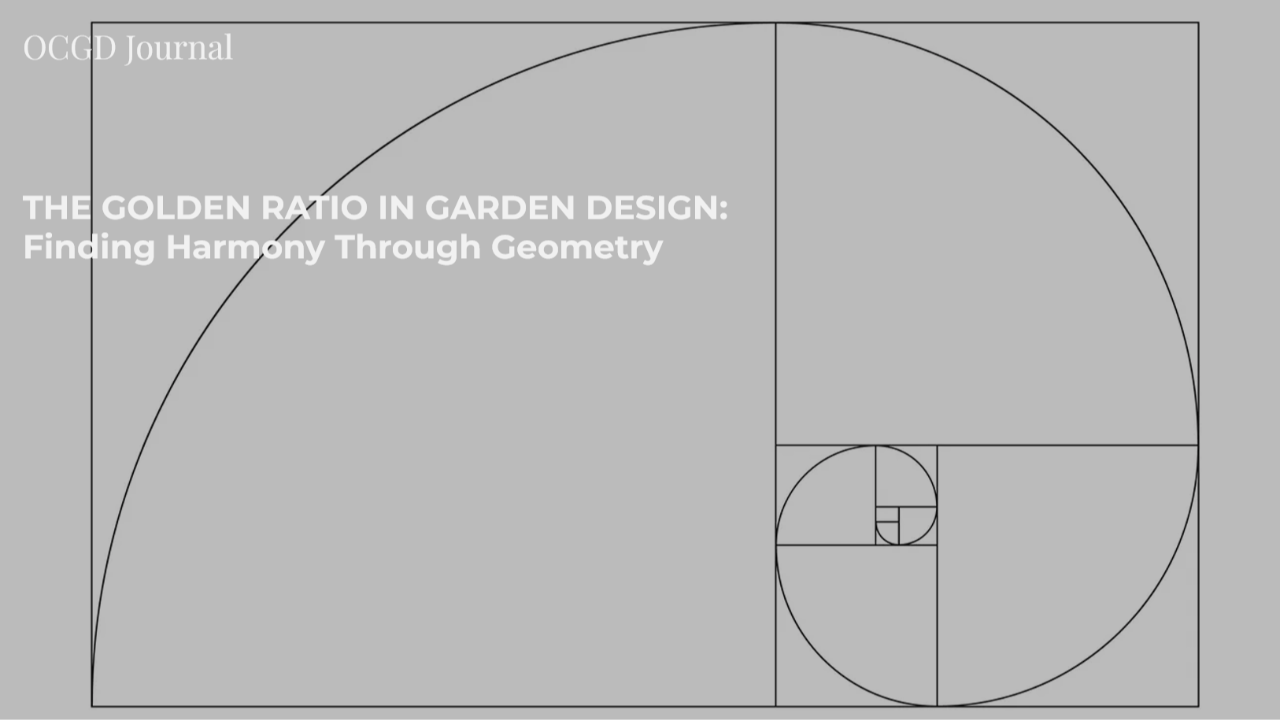
by Duncan Heather, Course Director at Oxford College of Garden Design
How can a mathematical relationship help us create beautiful gardens? The golden ratio offers a fascinating starting point for exploring proportion, balance and the geometry of outdoor spaces.
You don't need to be a mathematician to appreciate the role of proportion in garden design. In fact, some of the most useful design principles are rooted in relatively simple mathematical relationships.
One of the most intriguing is the golden ratio, a proportion that has fascinated mathematicians, artists, architects and designers for centuries.
What is the Golden Ratio?
The golden ratio, also known as the golden section, golden mean or phi (φ), is approximately 1:1.618.
Put simply, if you divide a line into two unequal parts, the golden ratio occurs when the relationship between the whole line and the longer section is the same as the relationship between the longer and shorter sections.
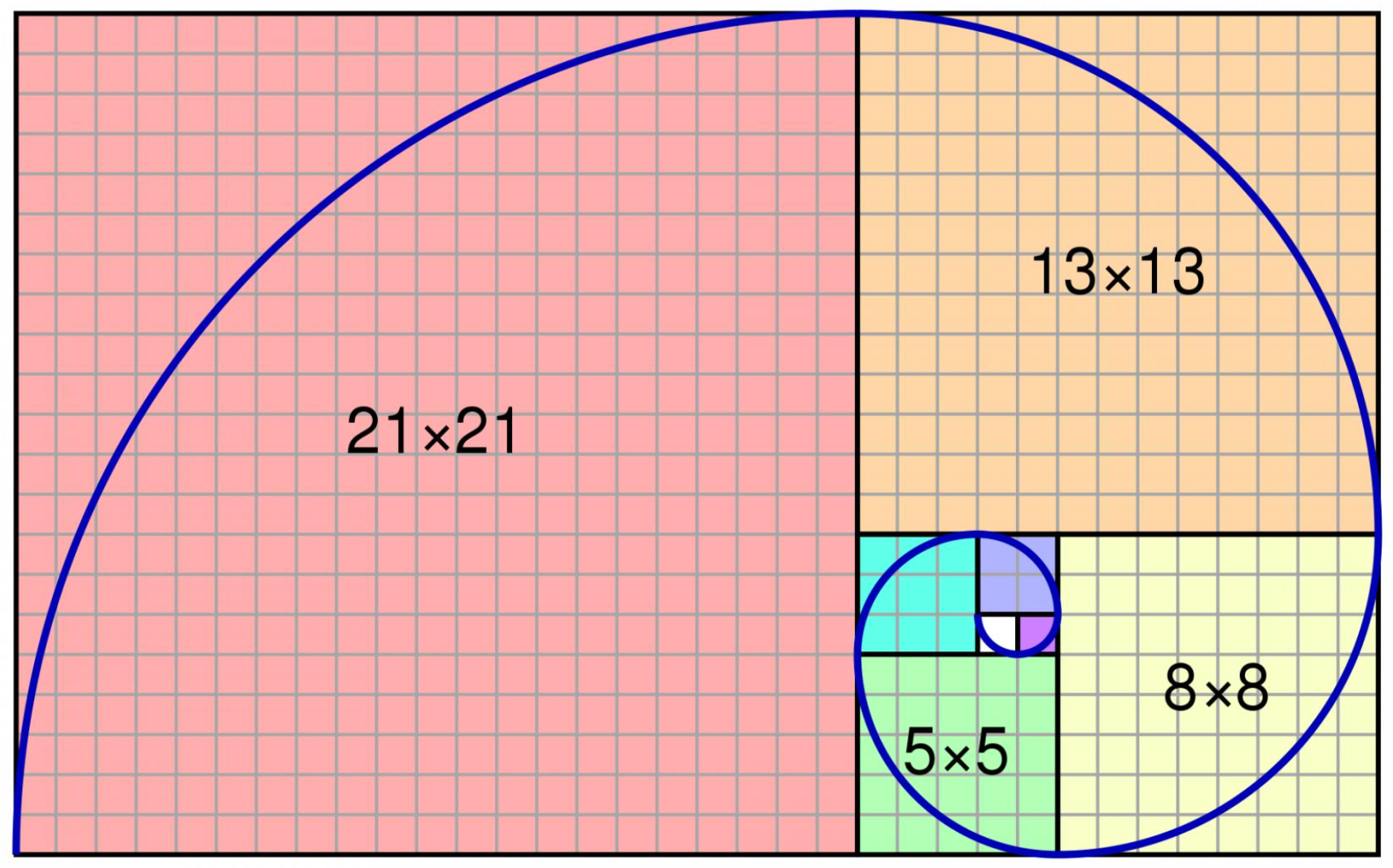
This proportion can also be used to construct a golden rectangle, where the longer side is approximately 1.618 times the length of the shorter side.
What makes the golden rectangle particularly interesting is its mathematical structure. Remove a square from one end and the remaining rectangle retains exactly the same proportions. This process can be repeated indefinitely, creating a sequence of progressively smaller rectangles.
For garden designers, this provides a useful way to explore relationships between spaces, dimensions and geometric forms.
The Golden Ratio in Nature, Art and Architecture
The golden ratio has long been associated with harmony and beauty.
Mathematical relationships connected to the golden ratio can be found in certain natural growth patterns, including the arrangement of leaves, seeds and flower heads. The Fibonacci sequence, closely related to the golden ratio, is particularly relevant to the spiral patterns observed in some plants.
Throughout history, artists and architects have also explored proportional systems as a way of organising compositions and creating visual balance.
The golden ratio is frequently associated with celebrated works of architecture and Renaissance art, although claims about its deliberate use in particular buildings or paintings are not always supported by historical evidence.
Nor is there conclusive evidence that we universally perceive golden proportions as more beautiful than other relationships.
Its value to designers lies instead in providing a coherent proportional framework: a way to introduce order, consistency and relationships between different elements of a composition.
Using the Golden Ratio in Garden Design
A garden is rarely a perfect rectangle, and there is certainly no requirement to impose golden proportions on every design.
However, the golden ratio can be a useful starting point when establishing the geometry of a space.
For example, it might help determine:
-
The proportions of a terrace or seating area.
-
The relationship between a lawn and surrounding planting beds.
-
The dimensions of a formal pool or water feature.
-
The subdivision of a larger garden into smaller, interconnected spaces.
-
The position and proportions of architectural features within a composition.
Even in an irregularly shaped garden, it may be possible to establish a strong underlying geometric framework that gives the design clarity and cohesion.
Importantly, the golden ratio is a design tool, not a formula for beauty.
Successful garden design also depends on scale, circulation, function, levels, planting, materials and the relationship between the garden and its surroundings.
A mathematically elegant plan is of little value if the resulting garden does not work for the people using it.
From Proportion to Composition
The golden ratio can influence more than the dimensions of individual spaces. It can also help us consider how a garden is experienced visually.
In photography and painting, compositional frameworks are used to position focal points, balance areas of interest and guide the viewer's eye. The same principles can be explored in garden design, although a garden has the added complexity of being experienced from multiple viewpoints and through movement.
A focal feature might be positioned according to a proportional division, while the arrangement of paths, planting and open space helps direct attention towards it.
This relationship between geometry and visual experience is particularly important in garden design. A successful composition must work not only when viewed as a plan, but also at eye level, from the house and as someone moves through the garden.
The golden ratio offers one way of exploring these relationships, alongside other principles such as symmetry, rhythm, repetition and visual balance.
The Fibonacci Sequence and the Golden Spiral
Closely connected to the golden ratio is the Fibonacci sequence, described in European mathematics by Leonardo of Pisa, known as Fibonacci, in the early thirteenth century.
The sequence begins:
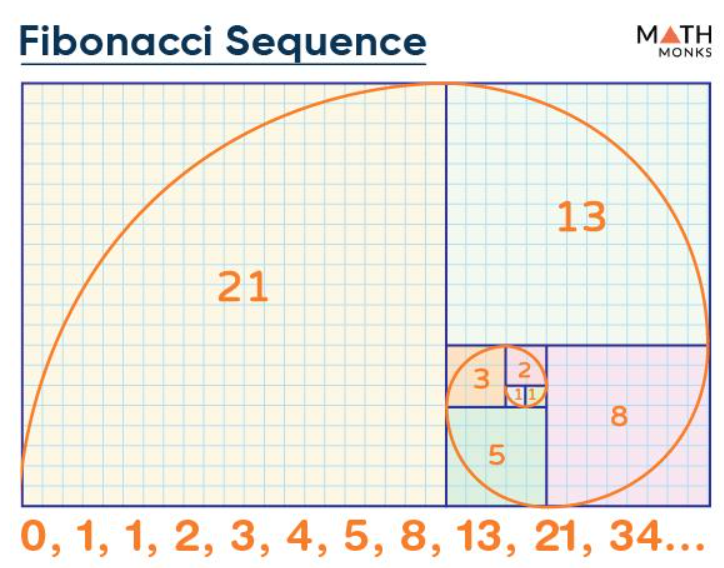
0, 1, 1, 2, 3, 5, 8, 13, 21, 34, 55, 89, 144, 233...
Each number is the sum of the two preceding numbers.
As the sequence progresses, the ratio between consecutive numbers approaches the golden ratio of approximately 1.618.
Squares whose side lengths follow the Fibonacci sequence can be arranged to create a series of adjoining rectangles. Drawing quarter-circle arcs through these squares produces a spiral that approximates the logarithmic golden spiral.
This is an appealing geometric form, with potential applications in paving patterns, paths, planting arrangements and other garden features.
But its use should always have a purpose within the wider design.
A Fibonacci Spiral in Practice
One particularly memorable garden commission demonstrated how mathematical geometry could become something much more personal.
The brief was to design a terrace set some distance from the main house, backed by a beautiful old brick wall. Sheltered and enjoying attractive views, the space had the potential to become a secluded destination within the garden.
The client had provided a relatively open brief. During the initial conversations, however, an interesting detail emerged: he was a lecturer in mathematics.
This presented an opportunity to introduce a design element that would connect the garden directly to his interests.
A Fibonacci spiral was incorporated into the paving, using blue engineering bricks to trace the geometric pattern against a terrace constructed from reclaimed bricks. The materials were carefully selected to complement the character of the existing wall.
The construction required precision. Achieving the curves and maintaining the intended geometry involved careful setting out and considerable brick cutting, with associated implications for cost and workmanship.
The result was more than a decorative paving detail. It created a point of interest, a conversation piece and a personal connection between the garden and its owner.
Geometry Is Only the Beginning
The most valuable lesson from this project is not necessarily about mathematics.
It is about listening.
Understanding a client's interests, experiences and relationship with their garden can reveal opportunities that would never emerge from studying the site alone.
Geometry provides a framework for organising space, but thoughtful garden design goes further. It brings together proportion, purpose, personality and place.
The golden ratio is one of many principles that can help us explore those relationships. Used with understanding rather than as a rigid rule, it can become a valuable part of a garden designer's creative vocabulary.
Exploring the Principles of Garden Design
This article forms part of our Garden Design Principles series, exploring the ideas and techniques that underpin thoughtful, successful garden design.
At Oxford College of Garden Design, we believe that understanding why a design works is just as important as knowing how to create it.
Discover our Diploma in Residential Garden Design to explore how these principles are applied through a comprehensive, professionally focused garden design education.
